
Where AI actually fits: a five-step method, worked on export operations
A repeatable way to find where AI belongs in a business: map the activity, size the pain with sourced numbers, match the work to the technology, then score the options on criteria you can argue with. Worked end to end on export.
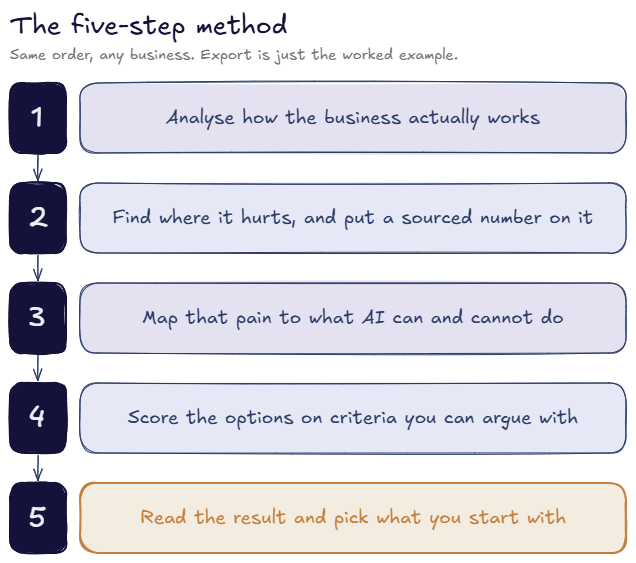
Start with the business, not the technology. Map how the activity actually works, find where it hurts and put a sourced number on it, match the nature of that work to what AI can do, then score the survivors on value, feasibility, risk and sponsorship. The shortlist falls out of the scoring. Tools come last.
This is not about tools, and it is not about the new LLM that comes out every week. You need to think first about the problems you have in your business and the business value, and only then whether the technology actually fits, including whether the cost of implementing it fits the state your business is in today. What follows is the method I run, worked end to end on one line of business: export operations. The frameworks transfer; the answers do not.
The example comes from real work: ExportAI, our own product, built with a North African client to find AI opportunities across export operations, and a consulting engagement with a UAE distributor moving electronics into African markets, covering the same ground of documents, clearance, partners and cash.
How do you work out how a business actually works?
Map the chain of activities, then attach a cadence to each one. Before any technology gets named, you want to know which activities repeat, which consume time, which an expert can do in a few minutes because of ten years of expertise, and which AI cannot do at all.
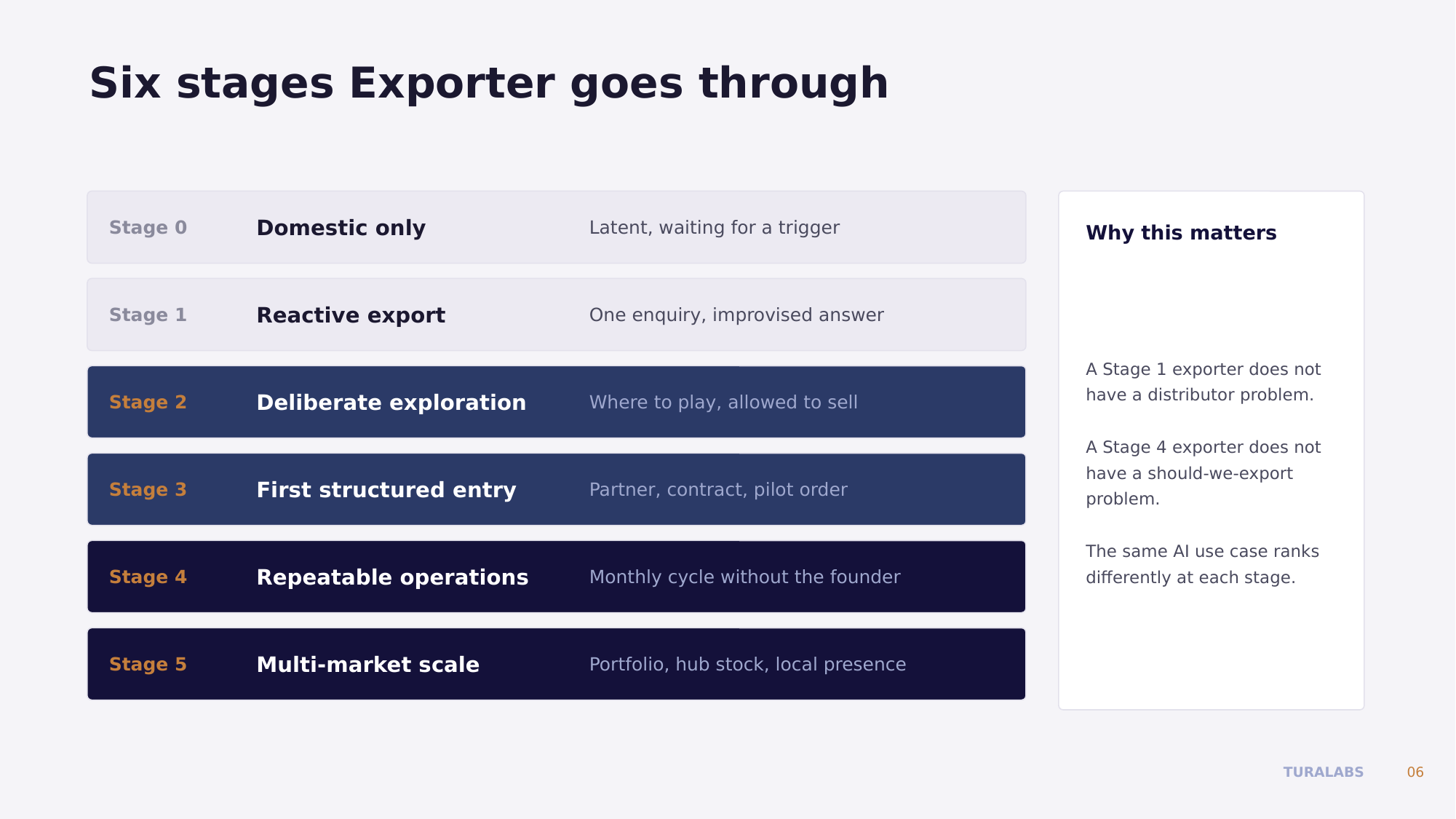
For an exporter, the first thing to establish is the stage. There are six, and the stage changes the answer more than the industry does.
Underneath the stages sit five activity chains that every exporter runs regardless of stage: market intelligence, market access, demand and partner, trade execution, and cash and growth. The first two happen once per market. The last three repeat forever, which is why they dominate the hours. Supporting them are three layers nobody in a small business owns: money, rules and records, and capacity and people.
Two cycles run through all of it. The deal cycle is months long and happens once per market: pick market, access path, find buyer, launch. The shipment cycle is weeks long and happens for every consignment: order, produce, documents, ship. Behind both sits a monitoring layer, market watch and regulatory watch, that usually does not get done because the export team has no time for it. That omission surfaces later as a shipment held at a border.
Turn all of it into an inventory of individual tasks with hours attached, and for this profile you land on roughly 40 core activities.
Where does it hurt, and how big is the number?
Sort the pain into four axes an executive already cares about, separate symptom from root cause, then attach a published number to each root cause. The four axes are money, time, risk and growth. A shipment held at customs is a symptom. Document mismatch, wrong HS code or a missing certificate is the root cause, and the root cause is what you fix.
Then size it. Some of this you get from talking to the team and following the steps they actually perform; the rest you can research online with any AI tool in an afternoon:
75%of the time it takes to get goods out of a country is administrative, not roads and not ports (Djankov, Freund and Pham, Trading on Time, World Bank).65-80%of bank document presentations are refused on the first attempt, a figure unchanged since 2007 (ICC Banking Commission).- Over
50%of new exporters stop exporting within a single year (Freund and Pierola; Eaton et al.; Albornoz et al.). - Non-tariff measures cost more than tariffs in
88%of countries, at3-4xthe tariff cost (UNCTAD, Global Trade Update, May 2026).
The one that changed how I think about this sector is the next one.
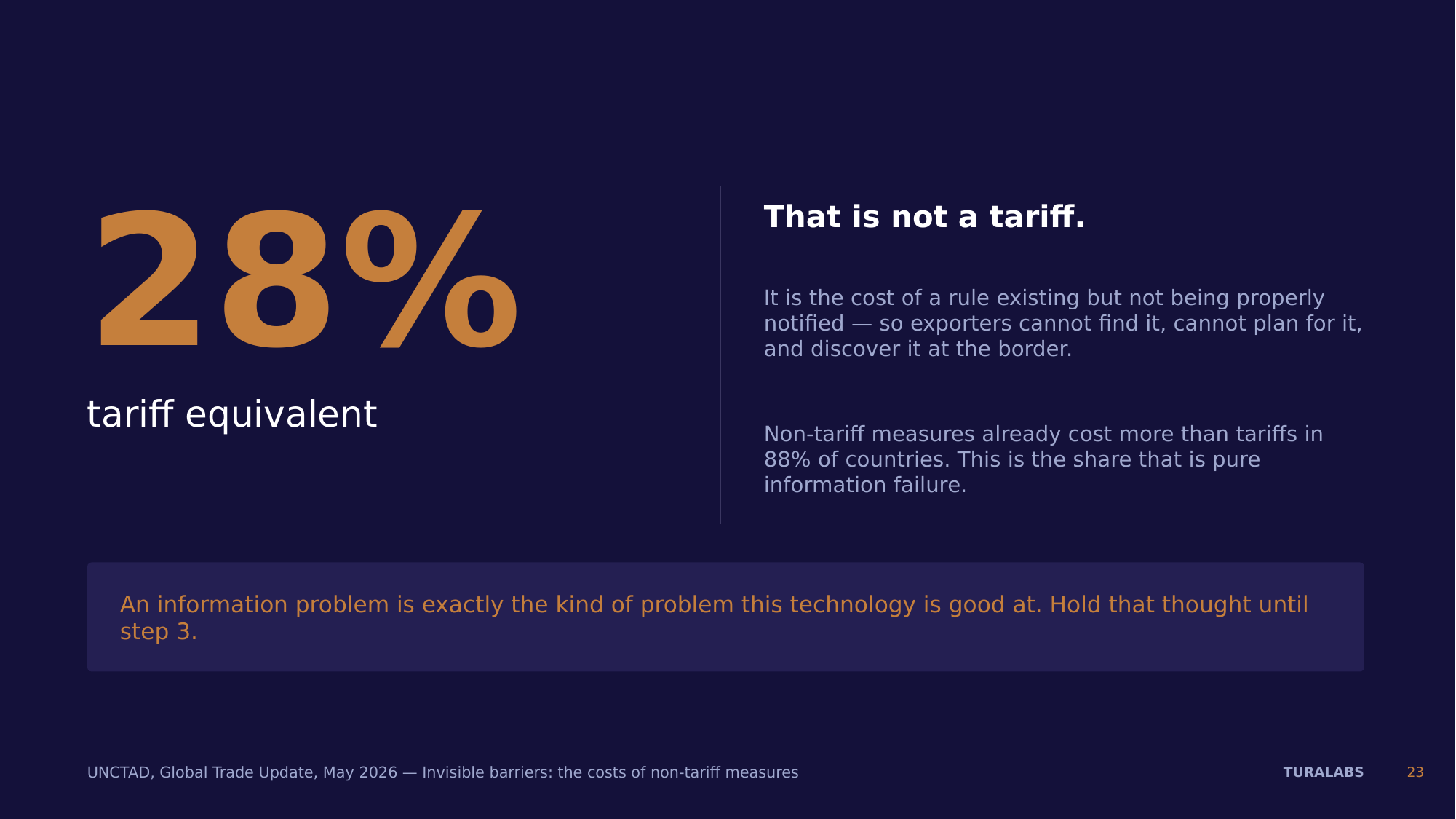
Rules that exist but are not properly notified cost the equivalent of a 28% tariff (UNCTAD, May 2026). That is not a tariff. It is the cost of information you cannot find, discovered at the border. An information problem is exactly the kind of problem this technology is good at, and that database is publicly available.
Numbers matter here for two reasons. Nobody funds a feeling: you do not commit a whole company to a project on a hunch about where AI might help. And the number sets the ceiling on what you can spend. If an issue is costing you $100,000 a year and the AI project needs $150,000, the project is wrong regardless of how good it is.
How much of that pain can AI actually do something about?
Filter first, then classify the nature of the work. A task earns a place on the candidate list only if it passes at least one of four tests.
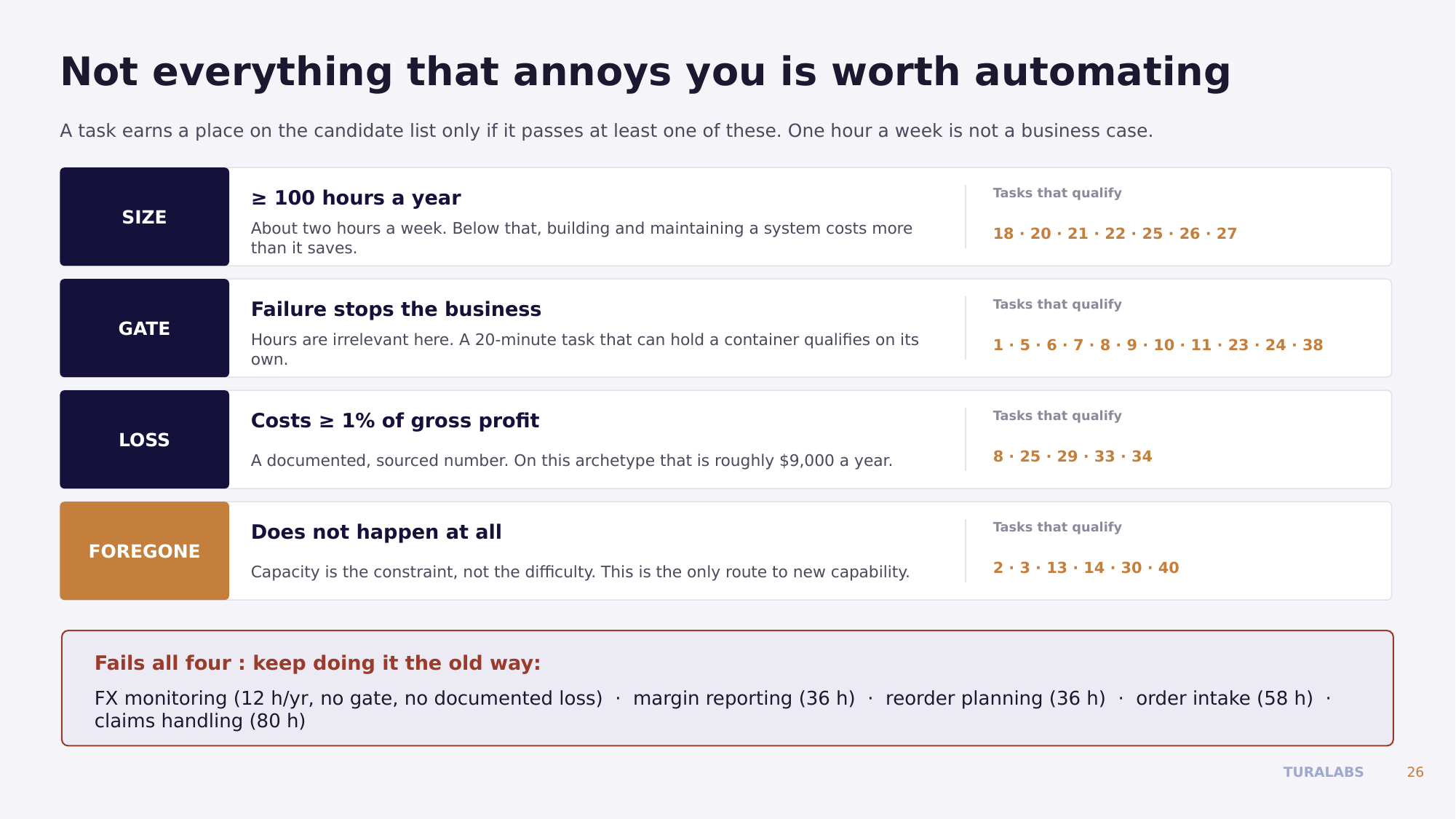
If something does not take more than 100 hours a year, do not consider it. Keep doing it the way you do it. If failing to do it has no impact on the business and generates no loss and no revenue lever, leave it alone as well. The fourth test is the interesting one: tasks that never happen at all because capacity is the constraint rather than difficulty. That is the only route on the list to a new capability rather than a saved hour.
Then classify what kind of work it is. Judgement and relationship work stays with people. If you go into luxury real estate, you cannot put an AI chatbot in front of the client. That is a premium segment and those clients are there for the human contact. Research, monitoring and chasing can be semi-automated, or done by a person augmented with AI.
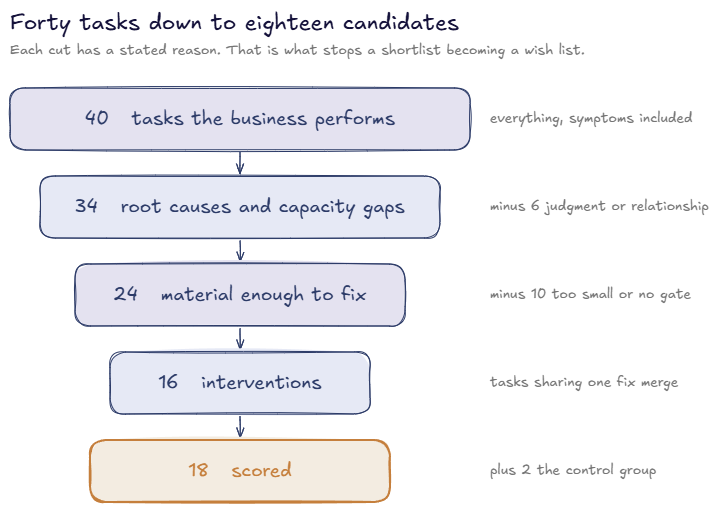
Sixteen survive. I added two more in a control row, because in practice the client or the department pushes you toward a specific AI solution whether or not the evidence supports it. Score those on identical criteria rather than arguing about them.
Now match each candidate to a technology by the verb, not by the department:
| Verb | What it looks like | Technology |
|---|---|---|
| Generate | Draft it | Generative AI |
| Retrieve | Find the rule | Retrieval over your own sources |
| Execute | File it, send it, chase it | Agents and workflow automation |
| Perceive | Read the scan | Vision, OCR, speech |
| Predict | Forecast, score | Classical machine learning |
| Optimise | Best load, best price | Optimisation algorithms |
| Decide | Which market, which partner | Stays human |
Finally, pair each candidate with one of the four reasons a business adopts any technology: grow revenue, reduce cost, improve outcomes, or add a capability you did not have. If a candidate does not map to one of those, it does not belong on the list.
How do you score the options?
Four dimensions, stated weights, scored one to five and averaged. Publishing the weights is the point: it lets someone disagree with a specific line rather than with your conclusion.
| Dimension | Weight | What it covers |
|---|---|---|
| Business value | 40% | Revenue, cost and time, risk avoided, decision quality |
| Feasibility | 35% | Data readiness, technical difficulty, integration, adoption |
| Risk when wrong | 15% | Consequence of an error and where the liability sits |
| Owner priority | 10% | Whether someone will sponsor it and actually use it |
Owner priority is small but it decides whether anything happens. Will it be sponsored by someone inside the organisation, so it gets used? Otherwise you are going to waste your time, even on something valuable, because the company is not ready for that implementation.
Scoring only means something against a named company. Here it is an exporter at roughly $2-5m in export revenue, around 10 consignments a month, 2-4 active markets, 1-3 people on export, an accounting system and no trade ERP. Change the profile and the ranking changes.
Two candidates show why. The cross-document consistency check reads the finished document set and flags mismatches before anything is submitted. It generates no new revenue, so business value is middling, but it needs no new data because the documents are the input, it runs on a folder of files, and it is appended to a step the team already performs. That last part matters more than it sounds: changing behaviour means friction, and friction means it does not get adopted.
Demand forecasting is the mirror image. It has the highest decision-improvement score of any candidate, and it scores 1 out of 5 on data readiness. You cannot forecast if you do not have enough data. With a few consignments you cannot forecast what you are going to sell in that market, and the markets you never entered produce no data at all.
What came out on top for this exporter?
Four candidates clear both bars: cross-document check, partner discovery, market-entry research, and the landed-cost engine.
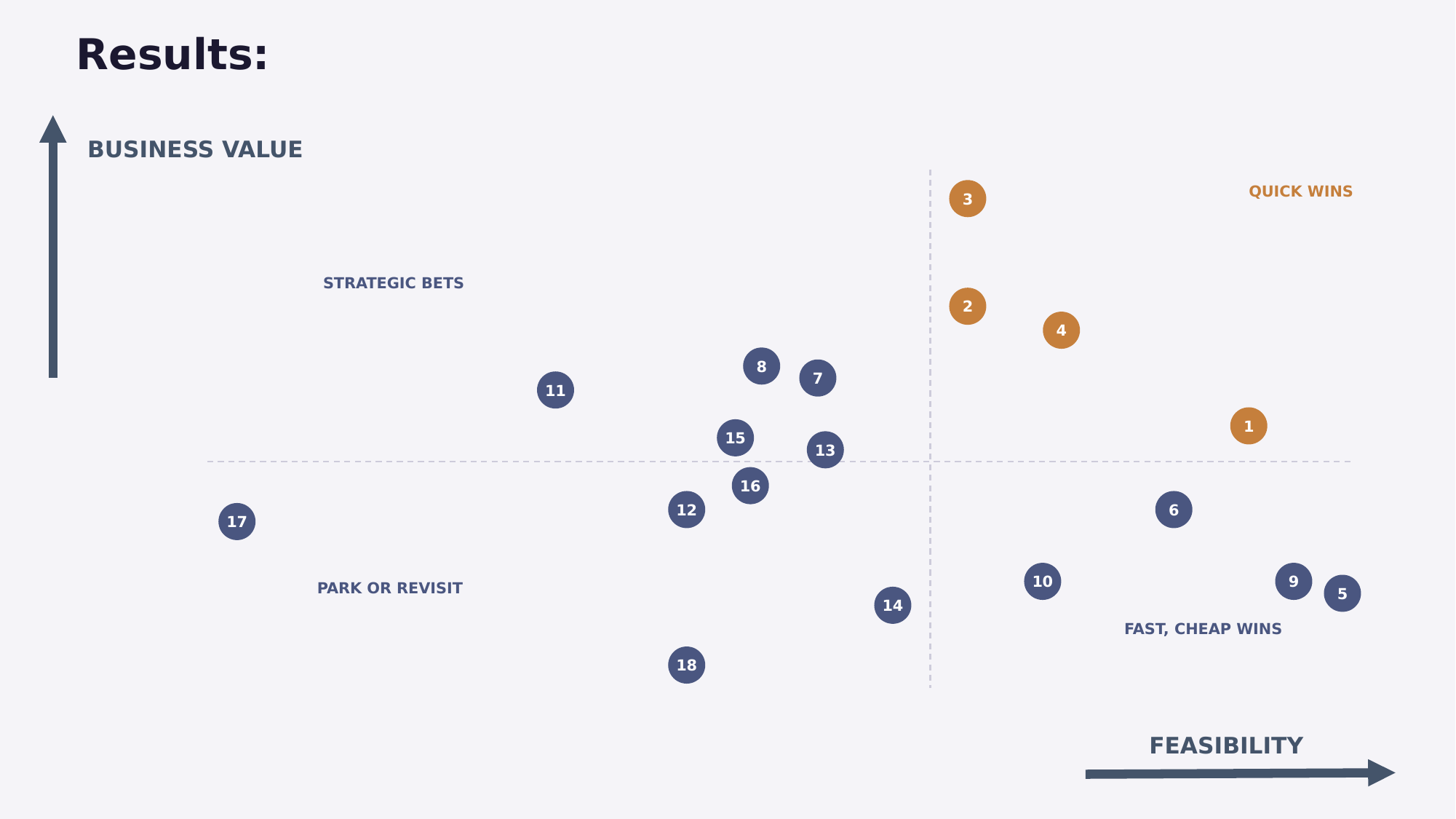
| Rank | Use case | Score |
|---|---|---|
| 1 | Cross-document check | 4.23 |
| 2 | Partner discovery | 4.12 |
| 3 | Market-entry research | 4.05 |
| 4 | Landed-cost engine | 4.02 |
Market-entry research and partner discovery come up constantly in conversations with exporters, so the scoring confirmed what I expected. One caveat on partner discovery: exporters want partners who are reliable and who actually want to sell. The reliability part is not something AI does. That goes through third-party organisations.
The top-right quadrant is where you start. Below it sit the fast, cheap wins, and sometimes we start there instead, because a client wants to see something quick and see the value of AI before investing more.
Does the answer change if my business is bigger or smaller?
Yes, and this is the part to take away rather than the ranking. The same eighteen candidates reorder by company size:
| Starting out | Growing brand | Large operator | |
|---|---|---|---|
| What changes | Nothing to integrate with, but no capacity to learn tools | Real systems to integrate; volume justifies automation | Data readiness improves; scale justifies a rule base |
| Top three | Landed cost, document check, market research | Document engine, document check, watchtower | Rule base, classification, forecasting finally viable |
If you are starting out you do market research, identifying the right market and the right HS code. If you are a growing brand it moves to the document engine, the document check, and watching what is happening. Larger operators can finally justify forecasting, because they have the data.
Watch the full walkthrough
Frequently asked questions
How do you decide if a task is worth automating with AI?
A task earns a place on the candidate list only if it passes at least one test: it consumes at least 100 hours a year, its failure stops the business, it costs at least 1% of gross profit, or it never happens at all because nobody has the capacity. One hour a week is not a business case.
Why score AI use cases instead of just picking the obvious one?
Because the obvious one is usually the loudest complaint, not the biggest leak. Scoring on business value, feasibility, risk when wrong and owner priority forces every choice into the open, so anyone in the room can argue with a specific number rather than with your judgement.
Does this method only work for export businesses?
No. Export is the worked example because two client engagements gave us the detail. The method itself is generic: map the activity chain and its cadence, sort the pain into money, time, risk and growth, match the nature of the work to a technology, then score against a named company profile.
When is AI the wrong answer to an operational problem?
When the work is relationship-based or judgement-based, when the data does not exist at the volume a model needs, and when the real fault is process or governance rather than technology. Changing how a team works costs nothing in software and often removes the problem entirely.
What kind of AI does an export operation actually need?
Mostly retrieval, not prediction. The answer is usually already written down in a tariff schedule, a letter of credit or a contract, and the work is finding and assembling it. Prediction needs outcome data at volume, and a company shipping around 120 consignments a year does not have it.
What's next
I am planning to run this same analysis on other lines of business, so tell me in the comments which one you want to see next.
If you want an audit like this one done on your own business or professional activity, book a strategy call.